Sunday, October 20, 2019

Church Entrance

Churches of Palma
Palma, Mallorca
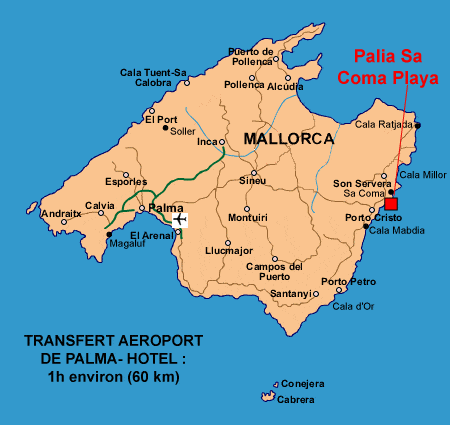

Image result for sa coma majorque
Mallorca
Mallorca
                                   Palma (Link 2.)


"
Mallorca is the largest island in the Balearic Islands, which are part of Spain and located in the Mediterranean. 
"The capital of Majorca, Palma, was founded as a Roman camp called Palmaria upon the remains of a Talaiotic settlement. The turbulent history of the city had it subject to several Vandal sackings during the fall of the Western Roman Empire. It was later reconquered by the Byzantines, established by the Moors (who called it Medina Mayurqa), and finally occupied by James I of Aragon. In 1983, Palma became the capital of the autonomous region of the Balearic Islands.


"Since the 1950s, Majorca has become a major tourist destination, and the tourism business has become the main source of revenue for the island." (Link 1.)

Altar

Rear of Church and Balcony

Interior Altar

Church Plaque

******

Photos: Taken with iPhone by RW while traveling in Mallorca from his home in
                Switzerland.
Link 1: https://en.wikipedia.org/wiki/Mallorca
Link 2:  http://www.onparou.com/Hotels-Baleares/Majorque/3-etoiles/Hotel-Club-Framissima-Palia-Sa-Coma-


                                                                         Prayer


God, be with persecuted Christians throughout the world. Amen (SW.)

Sunday, October 6, 2019


Calvary Church

Calvary Church
Pollenca, Mallorca


Church Plaque

Church Altar

Church Altar

"Pollença ... is a town and municipality situated in the northern part of the island of Majorca, near Cap de Formentor and Alcúdia. It lies inland, about 6 km (4 mi) west of its port, Port de Pollença.


Steps to Calvary Church

Steps to Calvary Church

"One of the town's most distinctive features is the 365-step stairway north of the square; this leads up to a chapel on top of the hill known as Calvary. On Good Friday this is the setting for the most dramatic parade of the year. First, on the road winding up the back of the hill, there is a reenactment of the Stations of the Cross. This is followed by a mock crucifixion on top of the hill after which the figure of Christ is ceremonially removed from the Cross. There is a sombre, torchlit parading of the body of Christ through the town led by hundreds of people in cloaks, masks and pointed hats and done in total silence save for the slow beating of a drum. "(Link 1)


View of Pallenca from Calgary church

Photos: Taken in Dec. 2018 by RW with his iPhone while travelling by bike to 
                 Mallorca from his home in Switzerland.
Link 1: https://en.wikipedia.org/wiki/Pollen%C3%A7a
                                                                    Prayer


God, be with persecuted Christians throughout the world. Amen (SW.)

Sunday, September 8, 2019

Sacred Heart Catholic Church
Kimberley, B.C.

Sacred Heart Catholic Church
Kimberly, B.C. Canada


Church Sign
"The first Catholic Church influence in Kimberley was initiated by Father Coccola, the famous priest, missionary and explorer who visited the new mines on the "hill" during the period of 1900-1910. Periodic visits were made by the missionaries from St. Eugene's and in 1910, when work assumed larger proportions, another great missionary, Father Duplanil visited Kimberley. He would come up from the Mission to say Mass in Joe Irwin's log cabin at 5:30 in the morning, as breakfast was at 6:00, and work began at 7:00 A.M.


"On April 16, 1911 the little mission had its first Easter Mass when Father Beck rode up from the Mission on horseback and said Mass in Tom Summer's Store, on Spokane Street.
"The spiritual needs of the Mission were attended to in like manner until 1922 when the first Sacred Heart Church was built by Father Bessette on the corner of Wallinger and Howard Street.
"It was a gala day when the church was blessed by Father Althoff, V.G. of Nelson, assisted by-Father Bessette and Father Stephen Murphy of Cranbrook. A choir and organist came from Cranbrook, and the little band of pioneer Catholics rejoiced that they had seen their dreams and hopes finally realized.
"History would not be complete without mentioning how our early pioneers worked together, regardless of race or creed. Not having their own choir or organist, Mr. and Mrs. John Dickson, parents of Mrs. J. J. O'Neill, volunteered their services, and the strains of Leonard's Mass in F wafted from the little church, sung by Mr. Dickson, a stalwart Presbyterian, and Mrs. Dickson, a staunch Anglican, who also played the organ. The Midnight Mass found Dick Burke holding a flashlight as Mrs. Dickson played and sang "Oh Holy Night".
"At the beginning of 1925 came the energetic Father Hartman, 0.M.I., under whose leadership the new church and rectory were built on the Church Hill and completed in 1927.

Sacred Heart Catholic Church

"... the parish hall was built in 1958. This proved to be a much needed asset for the parishioners, as it became the center of C.W.L., Knights of Colum-bus and catechetical activities, kindergarten, classes, teas and catering.
"In May of 1967 ...Father Doyle arrived in Kimberley ...As well as attending to the spiritual needs of the parish, Father Doyle and Father Martin worked arduously to improve the appearance of both the church and the grounds. The church was also Bavarianized to blend with the City's new look, making a most pleasing and fitting landmark to welcome incoming and departing visitors to Kimberley."  (Link.)


Parish Hall, Built in 1958

***********


Photos: Taken in 2019 by Amy Wilson while visiting in Kimberley.

Sunday, August 25, 2019

Entrance to Chapel & Prayer Room

London Airport Chapel
Gatwick Airport
London, England

"Our chapel & prayer rooms, located in both North and South Terminal, are open 24 hours a day to people of all faiths for private prayer and meditation. 
"Christian services are held regularly by the Anglican, Roman Catholic and Free Church chaplains. Buddhist services are held every Monday and on significant dates for major traditions. Services usually last 25 minutes, and details are posted on the noticeboard outside the chapel and on the chaplaincy website.
"The South Terminal chapel is on the third floor level near Caffè Nero (before security).

"he North Terminal chapel is on the first floor, before the entrance to Hampton by Hilton. "(Link 1.)
Chapel & Prayer Room


"Aside from a daily roster of services for various denominations and faiths, the Chaplaincy team serves the airport in a variety of ways including helping passengers, staff and visitors in matters spiritual, emotional and practical, often working with Travel Care, the airport charity assisting those who have missed planes, lost passports or otherwise run into problems. In major and minor emergencies, chaplaincy staff are trained to work with other emergency services to support passengers, families and staff, coordinating with the wider Emergency Responders network in Sussex.
"The Chaplaincy has played an active role during emergency situations over the years:
2004: Asian Tsunami
2011: Libyan crisis
2012: Blizzard closure and airport dig-out
2014: Virgin Airways emergency landing
2015: Tunisian terrorist attack urgent repatriation flights
"Some duties are less onerous, for example greeting Pope John Paul 11 when he arrived for his epic visit to Britain in 1982.

"The multifaith core of the chaplaincy mission is also continually developing with the recent addition of a Buddhist lay priest and a Muslim faith leader, offering regular services and pastoral support. Despite this growing diversity, the Gatwick Chaplaincy remains a mission primarily concerned with each and all of the 30,000 people routinely working in or passing through the airport, rather than specific denominations." (Link 2.)
                                                                  *********

Photos: Taken by RW  in Oct. 2018 with Iphone while travelling in London.                                                                

                                                                      Prayer


God, be with persecuted Christians throughout the world. Amen (SW.)


Sunday, August 11, 2019

St. Dunstan & All Saints Anglican Church

St. Dunstan & All Saints
the Parish Church of Stepney
London, England

"St Dunstan's, Stepney is an Anglican Church which stands on a site that has been used for Christian worship for over a thousand years. It is located in Stepney High Street, in StepneyLondon Borough of Tower Hamlets.


Church Sign
"In about AD 952 the Bishop of London — who is also Lord of the Manor of Stepney — replaced the existing wooden structure with a stone church dedicated to All the Saints. In 1029, when Dunstan was canonised, the church was rededicated to St Dunstan and All Saints, a dedication it has retained.
"Up until the early fourteenth century the church served the whole of Middlesexeast of the City of London. Then new churches were built at Whitechapel and Bow. The existing building is the third on the site and was built of Kentish ragstone mainly in the fifteenth century (although the chancel dates from 200 years earlier). A porch and octagonal parish room were added in 1872.

"The church was restored extensively in 1899, at a cost of £5,600. The vestries and some of the main building were destroyed by fire on 12 October 1901, including the organ which had carvings by Grinling Gibbons. The restoration cost £7,084, and the church was re-opened in June 1902 by the Bishop of Stepney.
St. Dunstan and All Saints Anglican Church

"The ring of ten bells, the heaviest weighing 28¾ hundredweight, which hang in the belfry, were cast at the local Whitechapel Bell Foundry and are tuned to C#. The seven oldest bells were cast by Thomas Mears and Son, Whitechapel, in 1806. The bells were re-hung in 1899.[1] Three were recast in 1952 when repairs were made to the tower.[3] The bells are mentioned in the nursery rhyme Oranges and Lemons: "When will that be, say the bells of Stepney."

St. Dunstan and All Saints Anglican Church

"The church has a long, traditional link with the sea and many sailors were buried here. It was once known as the 'Church of the High Seas'. " (Link.)

St. Dunstan & All Saints Anglican Church

********

Photos: Taken by RW  in Oct. 2018 with Iphone while travelling in London.                                                                  

                                                                   Prayer


God, be with persecuted Christians throughout the world. Amen (SW.)

Sunday, July 28, 2019


St. Mary's Cable Street

St. Mary Cable Street Church of England
London, England


"This parish, originally part of Christ Church, Watney Street, was a very poor slum know as Sun Tavern Fields, or No Man's Land. The Vicar of Christ Church, William Quekett, had opened schools in arches under the London and Blackwall Railway, and in 1847 he appealed for funds to build permanent schools and a church. Lord Richard Grosvenor laid the foundation stone of a new school, designed by George Smith, who was architect to the Mercers' Company, on 2 May 1848. This was opened on 12 October 1849 on the same day that Lord Haddo, the eldest son of the Earl of Aberdeen, laid the foundation stone of the new church.


Entrance

"Lord Haddo had known the district for some years, having been connected with St Jude's Whitechapel, and had admired the work of Mr Quekett. When he had heard about the need for a church in the area he at once offered to build and endow one. Frederick J Francis, the architect of St Jude's, designed a simple church without a tower and spire, which was to seat 1000. The idea of adding a tower and spire occurred to Lord Haddo while the church was being built, and Francis was told to design and build them. The total cost of building St Mary's Church, including an endowment of £3,200, was £10,000.

"The building was consecrated by the Bishop of Winchester on 22 May 1850, on which occasion the donor modestly sat at the back of the church and refused an invitation to the luncheon that followed. The dedication to St Mary was made at Lord Haddo's request as a tribute to his wife.

"The church is designed in the early 'middle-pointed' style of the early fourteenth century, and built in brick faced in coursed limestone. It consists of a nave and aisles of five bays with a shallow chancel. The base of the tower forms the lower vestry. A room at first-floor level, open to the chancel to the north, was probably originally intended as the organ chamber, but now serves as the upper vestry. There is a small gallery at the west end of the nave. Galleries were probably intended for the north and south aisles, but these were never constructed.


Altar

"There are two fonts, both by the west porch: one, the original, is a large stone construction with an unusual wooden cover. The second, a small wooden one, serves as a holy water stoup, and came originally from the chapel of a home for fallen women in Paddington.

"The original pulpit was of stone, but was later replaced by one of carved oak, said to have come from a demolished City church c1880. This, and the original choir stalls, were removed in the re-ordering of the church in 1986. In the short chancel, the High Altar and tester above it were installed in the 1950s as a memorial to Fr Robert Thornewill, who was the Vicar from 1914 to 1950. The nave altar and reordering were executed in memory of Fr Peter Clynick, the Vicar from 1959 to 1985.


Sanctuary and Altar

"One of the more remarkable pieces of furniture in the church is a lectern of carved wood, representing an angel with outstretched wings, above an anchor. The base and stand are of different origins, and the piece predates the building of the church, probably made up from late seventeenth century woodwork. The communion rails in the south aisle are of a similar date. The painted altar in the south aisle came from a convent in Kilburn, c1890. On the wall of the south aisle hangs an unusual memorial board with names, including donors, from 1864 to 1956.

"In the north aisle there is a series of five stained glass windows, c1930, by Christopher Charles Powell. They illustrate various incidents in the life of the Blessed Virgin Mary: the Annunciation, the Visitation, the Birth of Christ, the Presentation in the Temple and the Epiphany. The pipe organ was installed very soon after the consecration of the church, and is a virtually unaltered early example of the work of 'Father' Willis." (Link  3.)

*********

Photos: Taken by RW  in Oct. 2018 with Iphone while travelling in London.                                                                                                                        
Link 1:  https://www.facebook.com/pg/StMarysCableSt/about/?ref=page_internal

Link 2:  http://stmaryscablest.blogspot.com/

Link 3:  http://stmaryscablest.blogspot.com/2007/11/st-marys-cable-street-brief-history.html      

                                                                        Prayer

God, be with persecuted Christians throughout the world. Amen (SW.)

Sunday, July 14, 2019

s
St. Paul's Anglican Cathedral

St. Paul's Anglican Cathedral
London, England

"St Paul's Cathedral, London, is an Anglican cathedral, the seat of the Bishop of London and the mother church of the Diocese of London. It sits on Ludgate Hill at the highest point of the City of London and is a Cathedral, dating from the late 17th century, was designed in the English Baroque style by Sir Christopher Wren. Its construction, completed in Wren's lifetime, was part of a major rebuilding programme in the City after the Great Fire of London.
"The cathedral is one of the most famous and most recognizable sights of London. Its dome, framed by the spires of Wren's City churches, has dominated the skyline for over 300 years."[At 365 feet (111 m) high, it was the tallest building in London from 1710 to 1967. The dome is among the highest in the world. St Paul's is the second-largest church building in area in the United Kingdom after Liverpool 

St. Paul's Anglican Cathedral
"St Paul's is unusual among cathedrals in that there is a crypt, the largest in Europe, 
"Internally, St Paul's has a nave and choir in each of its three bays....

"A clock was installed in the south-west tower by Langley Bradley in 1709 but was worn out by the end of the 19th century....The present mechanism was built in 1893.

"The organ was commissioned from Bernard Smith in 1694.[59] The current instrument is the third-largest [57] in Great Britain in terms of number of pipes (7,189), with 5 manuals, 189 ranks of pipes and 138 stops, enclosed in an impressive case designed in Wren's workshop and decorated by Grinling Gibbons
"The southwest tower also contains four bells, of which Great Paul, cast in 1881... at 16
 12 long tons (16,800 kg) was the largest bell in the British Isles until the casting of the Olympic Bell for the 2012 London Olympics" (Link.)
*********
Photos: Taken by RW  in Oct. 2018 with Iphone while travelling in London.
Link : Cathedral.https://en.wikipedia.org/wiki/St_Paul%27s_Cathedralade I listed building


                                                                         Prayer


God, be with persecuted Christians throughout the world. Amen (SW.)